You don't find your tone of voice by picking three adjectives, you find it by listening to how you already talk when you're good at your job, then writing that down.
Most businesses I work with already have a voice, it's just not on their website. It's in the way the founder explains things on a call, the way the team reassures a nervous client, the opinions they share over coffee and never put in writing.
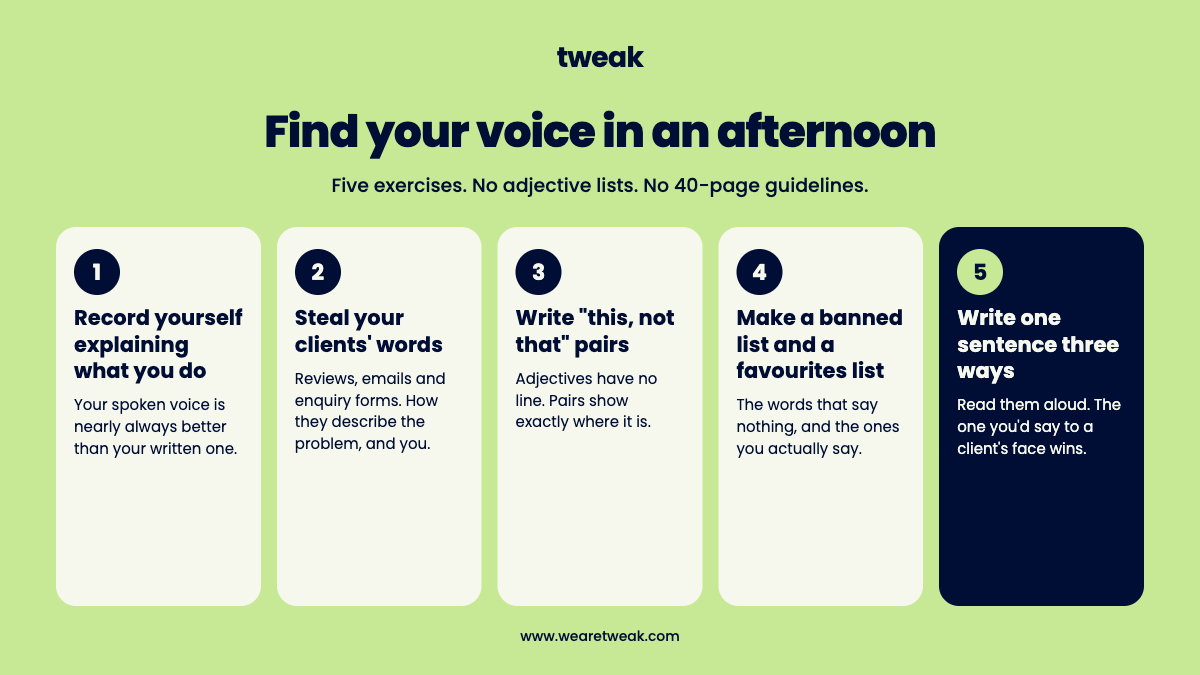
This article is the practical bit. I’ve highlighted five exercises I use with clients to get that voice out of people's heads and onto the page. You can do all five in an afternoon.
What actually is a tone of voice?
A tone of voice is a set of decisions about how your business sounds in writing: the words you use, the words you avoid, how formal you are and how much personality you let through.
The important word there is decisions. "Friendly, professional and expert" isn't a tone of voice, it's a wish. Nearly every business would describe itself that way, so it doesn't help anyone write anything.
A useful tone of voice tells the person writing a page what to do differently.
Exercise 1: Record yourself explaining what you do
Your spoken voice is almost always better than your written one. So start there.
Next time someone asks what you do, or on your next discovery call (with permission), record it. Or just open the voice notes app and explain your business to an imaginary friend for three minutes.
Then transcribe it and highlight:
The phrases that sound most like you
The way you describe the problem you solve
Anything you'd never dare put on your website but said out loud anyway
That last list is usually the gold, people are far more specific, funny and honest when they talk than when they write "About us".
[Optional: one line about a client whose recording surprised them, e.g. what they said on the call versus what their website said.]
Exercise 2: Steal your clients' words
Your clients will tell you how to describe your business if you let them. Gather:
Reviews and testimonials
Emails where someone thanked you or explained why they got in touch
The exact words people use on enquiry forms and first calls
Look for two things. How they describe the problem before they found you ("I didn't know where to start", "we kept getting the wrong enquiries"). And how they describe working with you ("you just told us straight").
Those phrases are your copy. They're also, very often, the words people type into Google or ask ChatGPT, which is a nice bonus.
Exercise 3: Write "this, not that" pairs
Adjectives on their own are useless because there's no line. Pairs show where the line is.
Instead of "we're friendly", write something like:
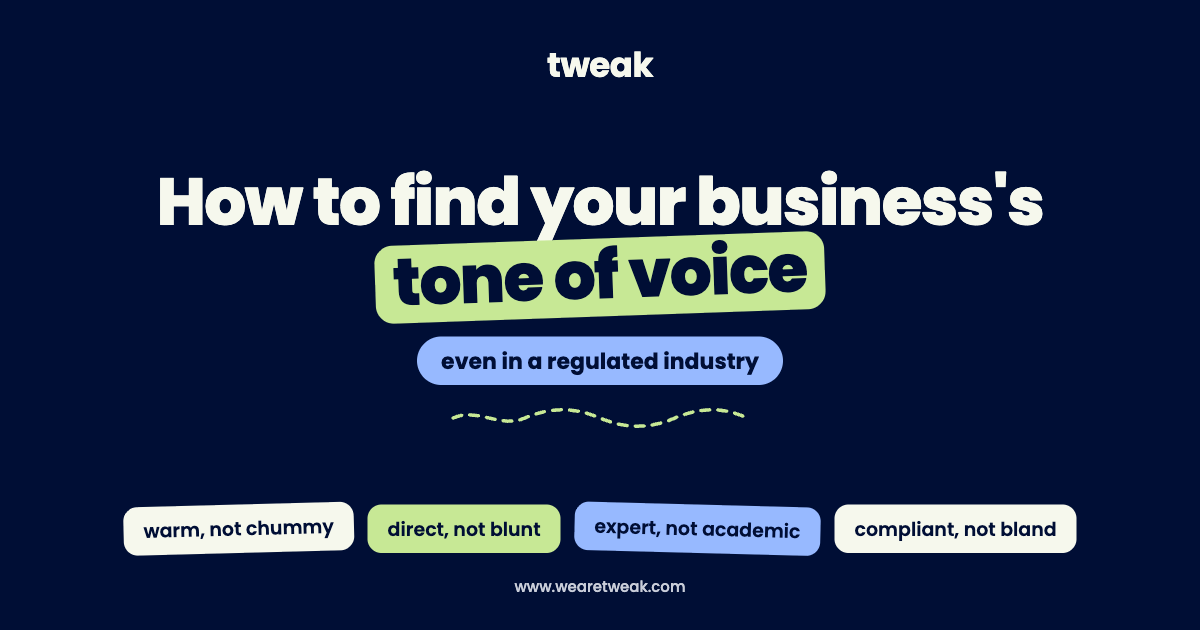
Warm, not chummy. We're kind, but we don't call clients "hun".
Direct, not blunt. We tell people the truth, with care.
Expert, not academic. We know the detail. We don't make you wade through it.
Confident, not salesy. We say what we're good at. We don't shout about it.
Aim for three or four pairs. Any more and nobody will remember them.
Exercise 4: Make a banned list (and a favourites list)
This is the most fun part, and the one people actually use.
Write down the words you never want to see on your website again. My usual starting list: bespoke, solutions, leading, passionate, comprehensive, innovative, tailored to your needs. Not because they're always wrong, but because they almost never tell the reader anything.
Then do the opposite. Which words and phrases do you and your team say all the time? What do you call your services out loud? If you call it "a website refresh" on calls and "a digital transformation programme" online, the call version wins.
Exercise 5: Write the same sentence three ways
Pick a question every client asks. "How much does it cost?" works well, because everyone's tempted to dodge it.
Write three answers. One very formal, one very casual, one somewhere in between. Read them out loud. The one you'd be happy to say to a client's face is your voice.
Here's a quick example for a family law firm: